
This guide initially displays common arthropods (insects, arachnids, centipedes/millipedes and crustaceans) of all shapes. Use the selectors below to include rare species, select by shape, or search by name.
Arthropods include several different classes: hexapods, arachnids, myriapods and crustaceans. An arthropod is an invertebrate animal with bilateral symmetry, an external skeleton, a segmented body, and jointed appendages arranged in pairs. In order to grow, arthropods have to molt, shedding their whole exoskeleton all at once.
Insects, which comprise the vast majority of hexopods, all have three basic body parts. The head has compound eyes, mouthparts, and antennae that are used as sensory organs. The thorax or mid-section typically has two pairs of wings, if the insect can fly, and three pairs of legs for a total of six. The abdomen contains the insect’s digestive system, reproductive organs and sting organs, if present.
While spiders make up the largest group of arachnids, others in the class include scorpions, harvestmen, ticks, mites, pseudoscorpions and solifuges. Arachnids have eight legs plus two additional pairs of appendages: chelicerae used for feeding and defense and pedipalps which function as a sensory organ or in reproduction. Arachnids do not have antennae or wings and have two main body parts with the head and thorax fused into one. In addition, they have two different types of eyes for a total of eight.
Centipedes and millipedes make up most of the myriapod species. They are best known for their long, segmented bodies with multiple legs, though far fewer than their names imply. In addition, they have a single pair of antennae, simple eyes, and mouthparts on the underside of their bodies.
Most crustaceans are free-living aquatic animals but a few are terrestrial such as the woodlice. Their bodies are composed of segments that are grouped into three regions: head, thorax and abdomen. Each body segment may have one or more pairs of appendages which serve as antennae, mandibles, maxillae, legs and tail.
Over 80% of all living animal species are arthropods. They occupy all kinds of roles: predators, prey, parasites, hosts, herbivores and decomposers and live in all different types of habitats. Many are particularly adapted to life in a dry environments like that of Southwest. This guide focuses on many of the common arthropods in the greater Los Alamos area. However, please note that insects in the Lepidoptera order are discussed separately in the Butterfly and Moth Guide.
Insect, Spider and Kin References
A Checklist of Plant and Animal Species at Los Alamos National Laboratory and Surrounding Areas
A Guide to Arthropods Bandelier National Monument, National Park Service [PDF]
American Arachnological Society
Arnett, RH, Jr. 2000 American Insects: A Handbook of the Insects of America North of Mexico CRC Press
BugGuide.Net
Encyclopedia of Life
Field Guide to Insects and Diseases of Arizona and New Mexico Forests, US Forest Service [PDF]
Grasswitz, T.R. and Dressen, D.R. Pocket Guide to the Native Bees of New Mexico [PDF]
Grasswitz, T.R. and Dressen, D.R. Pocket Guide to the Beneficial Insects of New Mexico [PDF]
A Manual of Grasshoppers of New Mexico
iNaturalist
Insect Identification, New Mexico
Mackay, W. and Mackay, E., 2001 The Ants of New Mexico (Hymenoptera: Formicidae) [PDF]
Museum of Southwestern Biology
New Mexico Spiders
Odonata Central
One Hundred Common Insects of New Mexico, NM State University [PDF]
Sanborn, A.F. and Phillips, P.K., 2013 Biogeography of the Cicadas (Hemiptera: Cicadidae) of North America, North of Mexico [PDF]
Symbiota Collections of Arthropods Network
Sutherland, C.A. Rove Beetles [PDF]
Symbiota Collections of Arthropods Network
Ticks and Tick Borne Diseases
Wildlife Notes – Centipedes and Millipedes [PDF]
Subject Area Experts (all guides)
Steve Cary (butterflies)
Beth Cortright (insects)
Terry Foxx (invasive plants)
Leslie Hansen (mammals)
Richard Hansen (fish, mammals)
Dorothy Hoard (butterflies, trees)
Chick Keller (flowers, herbarium)
Shari Kelley (geology)
Kirt Kempter (geology)
Garth Tietjen (reptiles)
David Yeamans (birds)
Web Development and Content Management
Pat Bacha
Jennifer Macke
Graham Mark
Akkana Peck
Contact
Please contact us for local nature questions and sightings. We welcome comments, corrections, and additions to our guides.
For more information about local nature, please visit our Nature Blog or subscribe to PEEC This Week.
Make Selection
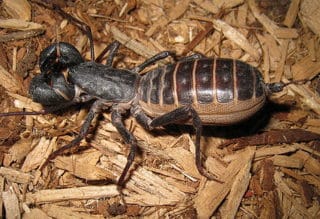 Photo: Jennifer Macke 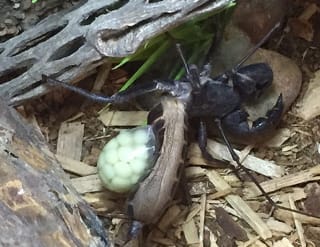 Photo: Jonathan Creel |  Giant Whipscorpion, Giant Vinegaroon(Mastigoproctus giganteus, Thelyphonidae family)Order: Thelyphonida (Whip Scorpions) Size: 1 - 3.5 in (25 - 89 mm) Distinguishing Features: two large claws and two front legs that are held aloft with the remaining six legs used for locomotion; a thin, flexible tail or “whip” extending from the abdomen Status: native; uncommon Habitat: dry areas beneath plant debris, in rock crevices or in burrows Giant Whipscorpions are actually more closely related to spiders than scorpions. Their first pair of legs is carried off the ground and used as sensory organs to detect both chemical and tactile stimuli. They take shelter during the day in burrows that they dig for themselves and come out at night to hunt for insects like cockroaches and crickets as well as other arthropods like millipedes. In order to defend themselves, Giant Whiptail Scorpions can spray a substance what is primarily acetic acid from a gland at the base of the tail. This spray, which gives these whiptails the common name of “vinegaroon”, can cause irritation and pain, especially if one gets it into one’s eyes. Females essentially sacrifice themselves to take care of their young. They literally starve to death by not leaving to feed while the young are unable to fend for themselves (female with egg case, bottom photo). Info Photos |
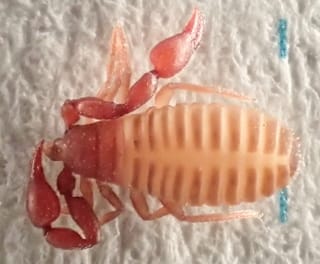 Photo: Phillipp Wickey 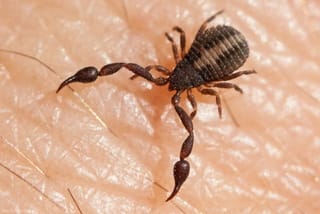 Photo: Ken-ichi Ueda | Pseudoscorpion, False Scorpion, Book Scorpion(Pseudoscorpiones family)Order: Pseudoscorpiones (Pseudoscorpions) Size: 0.1 - 0.3 in (2 - 8 mm) Distinguishing Features: looks like a tiny scorpion with a short, rounded abdomen, two very long pincers but without a tail or stinger; color varies by species Status: native; common Habitat: leaf litter, decaying vegetation and beneath tree bark; often in homes Pseudoscorpions are so small that they usually go unnoticed despite being common in many places. They are harmless hitchhikers, they often attach themselves to insects and come into homes with their ride. They are generally beneficial to man as they prey on insects like carpet beetles, clothes moth larvae, ants, mites, small flies and booklice. Booklice are the reason these creatures are often found in rooms with dusty books. Pseudoscorpions use their long pincers to catch their prey, inject them with paralyzing venom and pour digestive fluids over them. These tiny arachnids can make cocoons by spinning silk from a gland in their jaws. Info Photos |
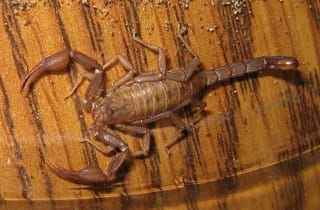 Photo: Jennifer Macke 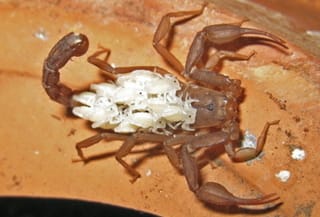 Photo: Jennifer Macke 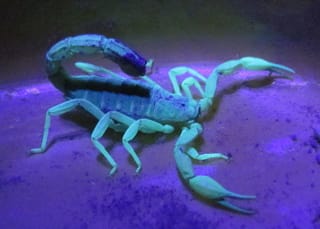 Photo: Randy Johnson | Scorpion(Vaejovidae family)Order: Scorpiones (Scorpions) Size: 0.8 - 4 in (20 - 102 mm) Distinguishing Features: two large grasping appendages in front; a narrow, segmented tail often carried curved forward over the back with a stinger at the end; coloring, striping as well as size depend on the particular species Status: native; uncommon Habitat: semi-arid areas with warm temperatures under logs, rocks, boards and clutter; some species live underground in burrows, while others may enter homes Scorpions are nocturnal, remaining in sheltered areas during the day to avoid predators and emerging only at night to feed. They are opportunistic hunters primarily catching small arthropods in their pincers and either crushing their prey or injecting venom. There are several different species of scorpion in the local area. These scorpions are not dangerous, though they can deliver a painful sting. The potentially deadly Bark Scorpion is not found in northern New Mexico. Scorpions are ovoviviparous, meaning that the eggs develop inside of the female and the young are born live. After birth the female carries the young with her for awhile (middle photo). Scorpions are know for their ability to glow blue-green under ultraviolet light (bottom photo). Info Photos |
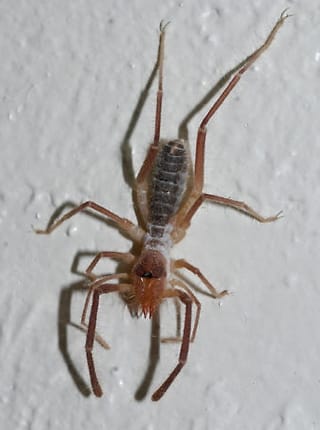 Photo: Sally King | Windscorpion, Sun Spider; Camel Spider(Solifugae family)Order: Solifugae (Wind Scorpions) Size: 0.4 - 2 in (10 - 51 mm) Distinguishing Features: looks similar to a scorpion or spider with eight true legs, a combined head and thorax, and massive mouth parts but without a tail or ability to make a web; many species have large central eyes Status: native; uncommon Habitat: semidesert, scrub, grassland, forest Windscorpions are neither true scorpion nor spider, though they are more closely related to the former than the latter. They lack the lung-like structures that scorpions and spiders have but rather breathe through three pairs of slits on their underside. Windscorpions are aggressive with a voracious appetite and incredible speed. They primarily feed on ground-dwelling arthropods such as termites and beetles. Once prey is located and captured, a windscorpion will cut it into pieces, liquify it and ingest the liquid material. Windscorpions do not have venom glands or any means of delivering venom but they can deliver a painful bite to a human. Info Photos |