
Initially this guide displays common birds of all types that are flying right now in our area. Use the selectors below to view rare birds, view birds flying any time, restrict the output to a certain shape of bird, or search by name.
New Mexico is on the western edge of the Central Flyway which is one of the major migration pathways between north and south for birds traveling between breeding and wintering grounds along the Rocky Mountains. This has resulted in the state having an incredible diversity of birds with over 550 different species reported. A little more than half of this number are sighted annually on the Pajarito Plateau. Some of these birds are full-time residents, some migrate here for a few weeks or months, and other are only seen briefly as they pass through the region.
This guide features many of the birds known to frequent Los Alamos county by when they are likely to be seen in the area. You can get additional information on local birds by joining PEEC Birders or going to the eBird website. eBird also includes lists of rare bird sightings and birding hot spots.
Bird References
Birdweb
Cornell Lab of Ornithology
eBird
eNature
Institute for Bird Populations
National Audubon Society
New Mexico Ornithology Society
What Bird
xeno-canto
Subject Area Experts (all guides)
Steve Cary (butterflies)
Beth Cortright (insects)
Terry Foxx (invasive plants)
Leslie Hansen (mammals)
Richard Hansen (fish, mammals)
Dorothy Hoard (butterflies, trees)
Chick Keller (flowers, herbarium)
Shari Kelley (geology)
Kirt Kempter (geology)
Garth Tietjen (reptiles)
David Yeamans (birds)
Web Development and Content Management
Pat Bacha
Jennifer Macke
Graham Mark
Akkana Peck
Contact
Please contact us for local nature questions and sightings. We welcome comments, corrections, and additions to our guides.
For more information about local nature, please visit our Nature Blog or subscribe to PEEC This Week.
Make Selection
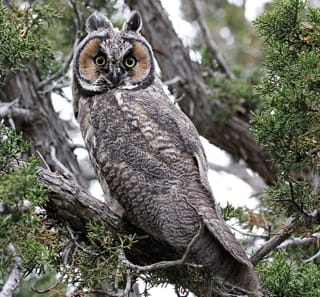 Photo: adult by Hari Viswanathan 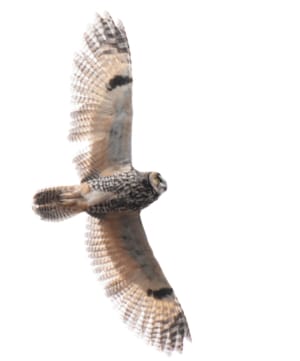 Photo: adult by Steven Mlodinow 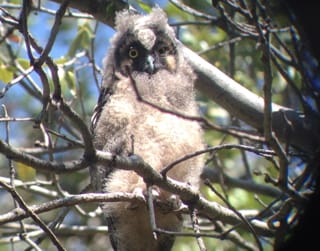 Photo: owlet by Scot Pipkin |  Long-eared OwlLEOW (Asio otus)Family: Strigidae (Owls) Size: 15 in (38 cm) Flies: Jan 01 - Dec 31 Morphology: adults are slender with black, brown, and buff patterning, long black ear tufts, a squarish head, and long, narrow orange facial disks, and yellow eyes Status: native; rare Food source: mostly small mammals, usually rodents, along with small birds and lizards Habitat: deciduous and evergreen forest Long-eared Owls tend to sit upright with ear tufts raised when at rest. They hunt at night by flying back and forth close to the ground in open woods looking for food. Once prey is located, an owl will swoop down to capture it in its talons. Like some other owls, the left ear opening on the Long-eared Owl is higher than the right. This helps the bird to locate prey by sound. These birds are mostly silent, calling less often than other owls. They are also unusual in that during winter they will often roost together in groups of a dozen or more. Long-eared Owls do not build nests but rather use one abandoned by another large bird. Young will climb out of the nest at about 3 weeks of age, start to fly at 5 weeks, and disperse at 1o to 11 weeks. Info Photos Distribution Frequency |
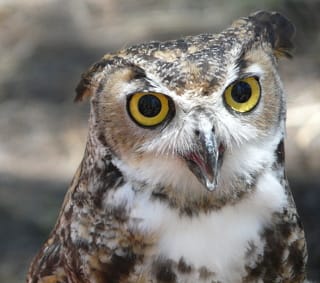 Photo: adult by Thomas Shankland 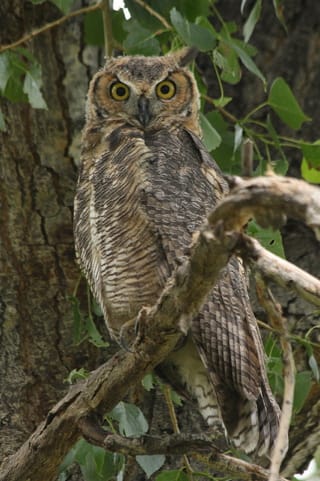 Photo: adult by J.N. Stuart 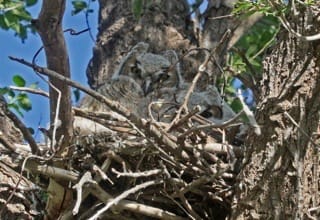 Photo: nest with young by Jerry Oldenettel | Great Horned Owl, Hoot OwlGHOW (Bubo virginianus)Family: Strigidae (Owls) Size: 25 in (64 cm) Flies: Jan 01 - Dec 31 Morphology: both sexes are mottled gray-brown with a reddish face, white patch on the throat, and two prominent feathered tufts on the head; birds in the Southwest are paler and grayer than elsewhere Status: native; common Food source: mostly eats mammals (rats, mice, rabbits, squirrels, skunks, etc.) and birds ranging in size from kinglets to herons; will also eat snakes and lizards Habitat: wooded areas with fields or other open areas The Great Horned Owl is a large bird that is aggressive and powerful, earning it the nickname of “Tiger Owl”. These birds have extremely good hearing and vision. They hunt mostly at dusk and after dark. They will watch from a high perch and then swoop down capturing prey in their talons. During northern winters, they may let uneaten prey freeze, only to come back later and thaw it out using their own body heat. Nesting may begin as early as late winter in some areas. This potentially allows the young to have enough time to learn hunting skills before the next winter. Nests are often those of other large birds with the addition of a few new feathers. The young will leave the nest at about 5 weeks old but cannot fly until 9 to 10 weeks of age. The parents may continue to fed the young for several months more. Info Photos Distribution Frequency |
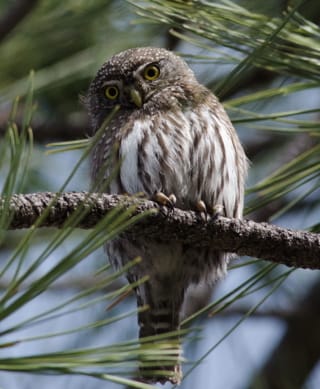 Photo: adult by Gordon Karre 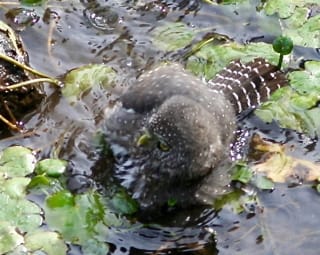 Photo: adult by Selvi Viswanathan 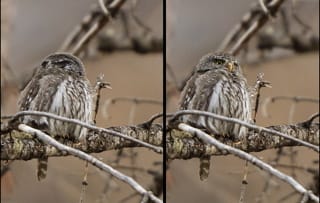 Photo: back and front of head by Mouser Williams | Northern Pygmy-Owl, Mountain Pygmy-OwlNOPO (Glaucidium gnoma)Family: Strigidae (Owls) Size: 6.3 - 7.1 in (16 - 18 cm) Flies: Jan 01 - Dec 31 Morphology: adults are brown overall with fine white spots on head and back and white stripes on tail; they lack ear tufts but have two dark patches on the back of the neck that look like eyespots Status: native; uncommon Food source: will eat rodents, birds, insects and lizards; prefers songbirds Habitat: open coniferous and mixed forests, open fields, and wetlands Typical location: Bandelier, Upper Canyons Northern Pygmy-Owls are very small and are often active during the day. They will wait quietly to spot their prey and then fly fast and low to grab their target. They can carry more than twice their own weight. These birds are aggressive and catch more birds than most small owls. In defense, gangs of songbirds, in particular chickadees, will often gather to “mob” a Northern Pygmy-Owl. During courtship, pairs will rapidly chase each other near potential nesting sites. They nest in tree cavities, often using old woodpecker holes and defend large territories during breeding season. Info Photos Distribution Frequency |
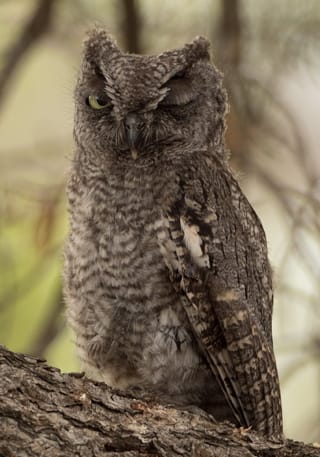 Photo: Corry Clinton 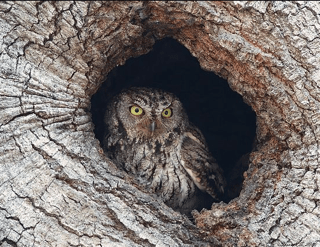 Photo: Shravans14 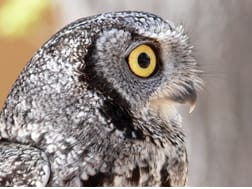 Photo: Sally King, NPS | Western Screech-OwlWESO (Megascops kennicottii)Family: Strigidae (Owls) Size: 7 - 10 in (18 - 25 cm) Flies: Jan 01 - Dec 31 Morphology: round head with ear tufts, yellow eyes, and yellowish bill; there are several morphs that range in color from brown to dark gray with streaked underparts; females are larger than males Status: native; common Food source: small mammals and large insects Habitat: wooded canyons, desert scrubland and farm groves The Western Screech Owl is a small, inconspicuous but fairly common owl found in many different habitats throughout the western US. Its call is not actually a screech, but more a series of short hoots at increasing tempo. Like other owls, it forages at night, hunting mostly from a perch from which it swoops down to take prey. It locates prey by both sight and sound. Western Screech Owls nest in a cavity in a tree or pole, often in an old woodpecker hole. The top photo was taken of an owl that was rescued after finding its way down a chimney. The female incubates the eggs for a little less than a month and the young fledge at about 4 weeks of age. However, both parents will take care of the young for awhile longer. Info Photos Distribution Frequency |
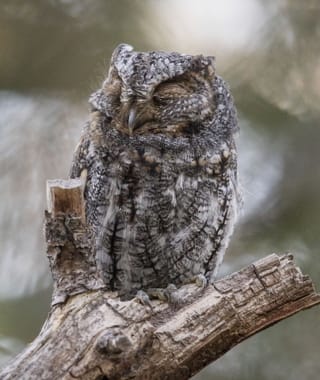 Photo: adult by Mouser Williams 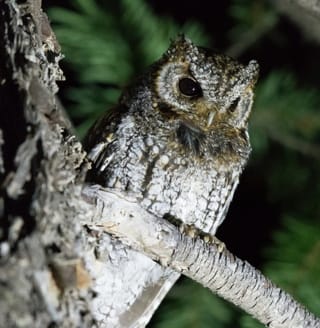 Photo: adult by Gordon Karre 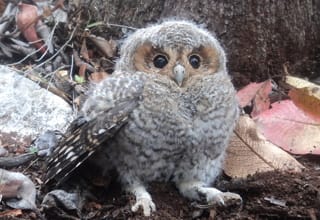 Photo: owlet by Leticia Soriano Flores | Flammulated OwlFLOW (Psiloscops flammeolus, Megascops flammeolus)Family: Strigidae (Owls) Size: 6 - 7 in (15 - 18 cm) Flies: Apr 21 - Jun 15 Morphology: small owl that is gray or brown overall with rounded facial disk, dark eyes, and short, feathered ear tufts Status: native; rare Food source: feeds almost entirely on insects such as moths, beetles, and crickets; will also eat some other arthropods such as spiders, centipedes, and scorpions Habitat: dry ponderosa pine woods, tuff Typical location: Upper Canyons Flammulated Owls are very well camouflaged, particularly when sitting near a pine tree trunk. Also their call is very soft and a bird will sing even more quietly if approached. This has resulted in their numbers being underestimated in many areas in past. New census techniques have now lead to these owls being considered to be the most abundant owls in the western pine forests. These birds mostly hunt just after dark and near dawn. They will perch on a branch looking for insects and then fly out to catch them either in the air, on the ground, or directly from foliage using their feet to grab their prey. Nests are usually in tree cavities, often old woodpecker holes. Young leave the nest to perch on nearby trees about 25 days after hatching. Info Photos Distribution Frequency |
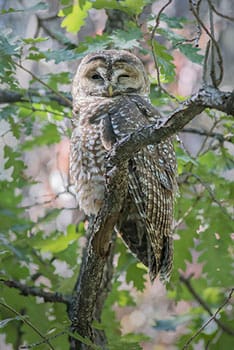 Photo: adult by Mouser Williams  Photo: adult by Mouser Williams 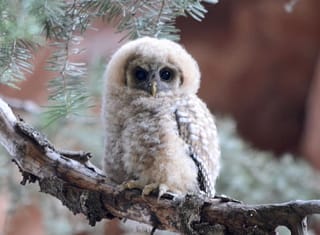 Photo: owlet by Sarah Stio, NPS | Mexican Spotted OwlSPOW (Strix occidentalis lucida)Family: Strigidae (Owls) Size: 18.5 - 19 in (47 - 48 cm) Flies: Jan 01 - Dec 31 Morphology: adults are dark-brown overall with white spots, rounded heads without ear tufts, dark brown facial disk with a pale “X” mark between the eyes, broad wings, and short tails; the Mexican subspecies found in the local area is paler in color and has larger white spots than other the other two North American Spotted Owl subspecies Status: native; rare; threatened Food source: mostly small mammals, in particular woodrats; will also take some birds, reptiles and large insects Habitat: evergreen forest Spotted Owls as a species are dependent on diminishing old-growth coniferous forests and as such have become the center of much controversy. The Mexican Spotted Owl is currently designated a federally threatened species. For this reason the location of sightings in the area are are not available online through databases like eBird. These birds hunt mostly at night by watching from a perch and then swooping out using their talons to catch their prey. Pairs often use the same nest site for life, but may not nest every year. Nests are usually in a sheltered site and consist of scrape debris. Unlike most owls, Mexican Spotted Owls do not defend their eggs and young from predators. Info Photos Range Frequency |