
© Steve Cary, April 1, 2026
We have four items for you this time around – a nice spring mix: a brief prize from Spain, Mike T’s summary of 2025 observations, my quick review of new metalmark names and places, and a photo-challenge for 2026. Enjoy the read and I look forward to your feedback.
Marcy and I recently returned from three weeks in southern Spain: Andalucia. What a wonderful and beautiful place! Awesome history, people, culture, food, landscapes. Spain really seems to be in a good place with a thriving economy and happy people. Incidentally, we also saw a few butterflies in the various natural and national parks. I did not plan to do any butterfly photography, but I did manage this snap with my phone while we were hiking near Bubión. iNaturalist suggested it was the Queen of Spain Fritillary:
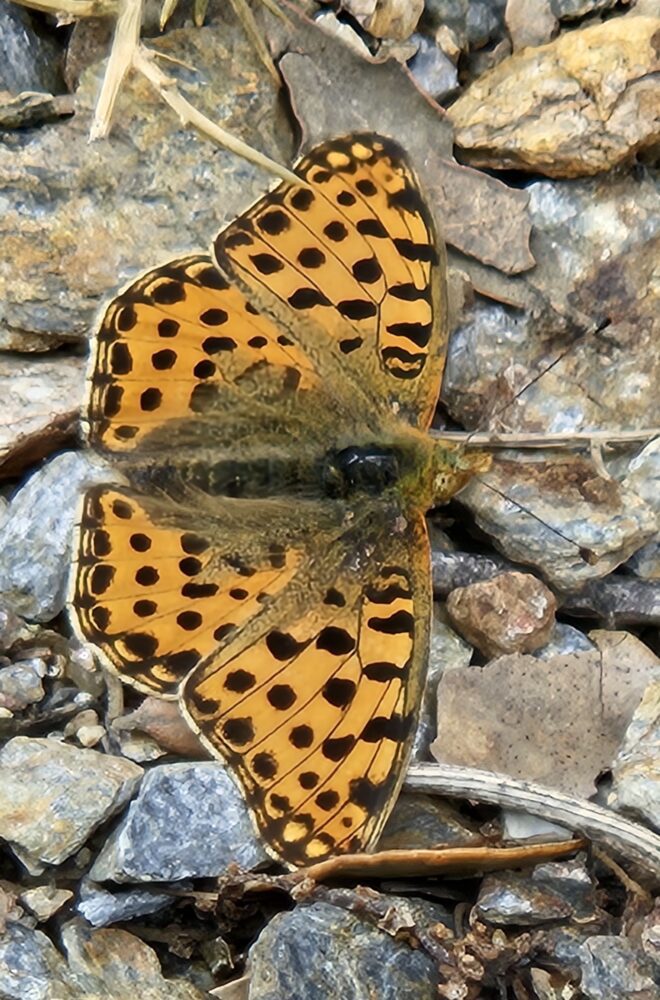
Overall we saw perhaps 10 species, plenty of Cabbage Whites and Painted Ladies, but in more natural habitats there were satyrs (probably Common Brown), a swallowtail (probably Old World Swallowtail) a Nymphalid and perhaps a copper. Andalucia seems to have a lot of natural and national parks that are accessible via roads and hiking trails, so therefore good places to chase butterflies. Also a lot of olive groves (yum).
Reviewing the 2025 season, by Mike Toliver. One of these days, I really will update our maps on BONM! Trouble is, you people keep finding new stuff! That, and the ever-changing nomenclatural landscape keeps me off the streets.
Looking back at 2025, I have to say that was a very special year for me. I got to do some real butterfly field work in my native state after a (very) long absence. In late July and early August, I traveled around the state with old friend Steve Cary (you may have heard of him) and new friend Simon Doneski (you will hear more about him) in search of various butterflies/localities. Since I wasn’t much of a butterfly photographer back in the day when I was first active in NM (1956-1975) there were a lot of butterfly species for me to photograph on this trip. I occasionally swung a net as well, with my primary success beaning a poor Southern Dogface which I accidentally whacked with my net rim in the Peloncillos.
But this is really supposed to be a review of what all of us found (at least those of us on iNaturalist and/or Butterflies of North America) in 2025. This will be a little different from my previous review of 2024 because more ways to think about these reviews crop up as I work my way through them. Perhaps the most radical change in this review is my inclusion of “unknowns” – critters that for one reason or another couldn’t be identified to species.
Of the 6,792 observations (potentially including some duplicates), 443 (approximately 7%) couldn’t be identified to species. There are a number of possible reasons for this, but the one I find most instructive is the inability to distinguish closely related species via photographs. Of those 443 “mystery” critters, 91 couldn’t be identified even to genus. I suspect the vast majority of those particular unknowns were unable to be determined at least to genus because the photos were inadequate to the task. Those of you who photograph butterflies in their natural habitat know why that happens: too far away, too fast, and the usual photographic mishaps.
It will come as no surprise to learn that of the 352 “unknown” observations that could be determined to genus, the majority were skippers (138 out of 352; almost 40%). The most troubling genera (again, no surprise) were Erynnis/Gesta: 53 of 138 – about 39 % of the skipper unknowns). The other genus worth mentioning is Burnsius, with 37 unknowns, almost all of which were the albezens/communis variety. I might suggest we should include all “identified” Burnsius “albezens” and “communis” (140 observations) as identifiable only to genus, which would substantially increase the number of Burnsius unidentified! Until we get an accurate way to identify these troublesome skippers from photos (I’m not holding my breath), our understanding of the ecology and distribution of these beasts will have to be based on dissected physical specimens. Grab your nets!
The other families with unknowns were Pierids (80 unknowns, mostly Colias), Nymphalids (79 unknowns, mostly Argynnis), Lycaenids (29 – Celastrina and Tharsalea being the main culprits), and Papilionids (26, 20 of which are Tigers).
Another reason for our inability to determine critters to species is that a number of photos are of immatures, which can be very difficult to identify to species. Some of the Papilionid photos were of imatures, and I suspect many of those were actually Two-tailed Tigers. Might I recommend Dave Wagner’s Caterpillars of Eastern North America: A Guide to Identification and Natural History (Princeton Field Guides Book 36)? It’s available from Amazon, including a Kindle edition. Even though the book is aimed at the eastern US, you would find much useful information about NM species as well. (Another good one is Caterpillars in the Field and Garden: A Field Guide to the Butterfly Caterpillars of North America, by Thomas Allen, Jim Brock and Jeffrey Glassberg.)
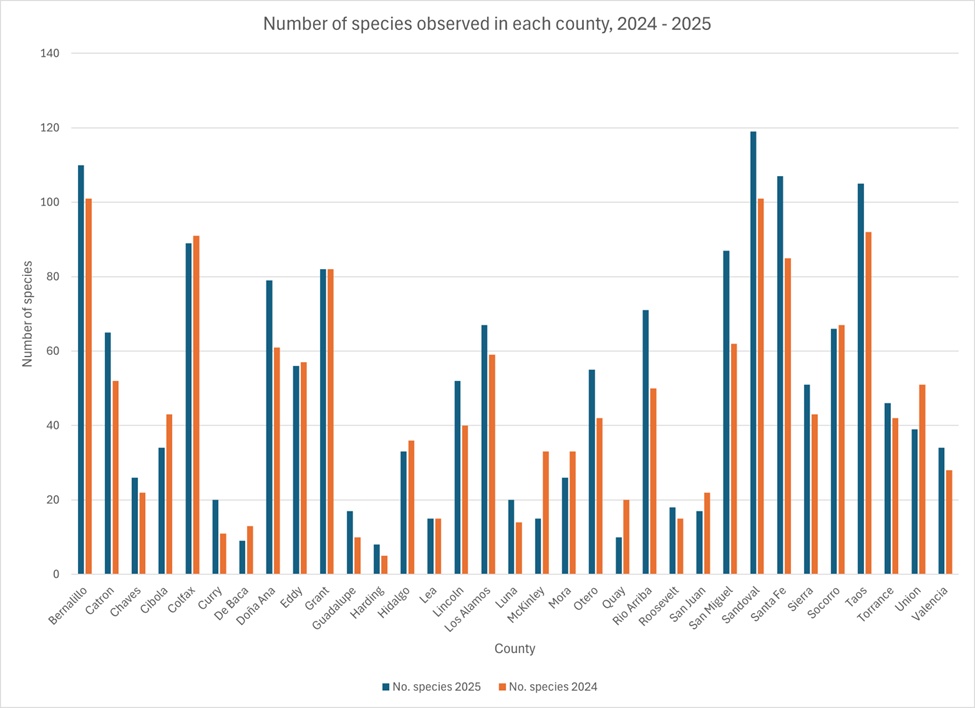
Now, on to the meat of the season! We made 6,792 observations (again, probably including some duplicates), which was close to the number of observations you made in 2024. We observed 224 species in New Mexico, compared to 245 in 2024. Once again, Bernalillo County had the highest number of observations (1248) because of the large number of observers. This year Bernalillo came in 2nd place in terms of number of species observed (110). Three of those species from Bernalillo were remarkable; Kricogonia lyside (June 24, by Tom Kennedy), Pontieuchloia beckerii (April 30 by miguel1958), and Papilio bairdii (April 25 by Nicolò Salaris).
Sandoval County had the highest number of species observed (119). Probably the most spectacular of those was Papilio indra minori, observed by Ashley Grant on July 8 on iNaturalist. Mike Andersen made 10 observations of the Hoary Elfin along the Rio Cebolla in the Jemez on May 23. Some were a bit worn, making them difficult to distinguish from the Brown Elfin, which occurs in the same place.
Doña Ana County came 2nd in terms of number of observations, no surprise there given the activity of our southern NM crowd. However, it ranked 9th in terms of number of species observed, probably because they were so dry until early summer. Some of the more noteworthy finds here were Pholisora albicirrus, Apodemia duryi and A. apache riftoria (what the heck is that?, you ask: there’s a new revision of the Apodemia mormo group which is discussed below and has been incorporated into BONM), Callophrys henrici solatus, and Anaea aidea. Steve has already posted about the late date competition down there, although I suspect few butterflies looked at our calendar.
The Santa Fe crowd (including yours truly, at least briefly) came in 3rd in both number of observations (653) and number of species observed (107). In my view, the most spectacular observation was Eurema proterpia on November 8, by julieluetzelschwab – a county record. Tailed Orange seemed to have a good year, with 14 observations spread around the state. I wandered up the canyon leading to the SE from the Randall Davey Audubon Center on August 5th. In the canyon, I saw mostly birds (White-winged Dove) and Fremont’s Squirrel. The butterflies were concentrated around the gardens surrounding the Audubon Center. I got a nice movie of a White-lined Sphinx visiting the various flowers there. Laurens R Halsey spotted a couple of Hoary Elfins on the same day Mike Anderson was seeing them in the Jemez. Hemiargus ceraunus showed up on June 25, observed by gremlinafter12. Pretty far north for this critter – perhaps a sign of things to come.
The high country in Taos County produced the usual (and unusual) treasures, including Lycaena cupreus, Erebia magdalena, and Oeneis melissa. You all found 105 species there, based on 406 observations.
Steve and I explored the Jicarilla trust land around Grouse Mesa (over 11,400’) on August 7. We were hoping to find Parnassius smintheus rotgeri there, but the habitat didn’t seem right and we struck out on that score. But we found other nice things, all potential new dots for our maps. These included Argynnis atlantis sorocko, a species we suspected was in northern NM but hadn’t yet been confirmed. This species also turned up in Taos County, including one observation as long ago as 2020. Other nice finds were Boloria myrina (we found that around Hopewell Lake in addition to the Jicarilla Trust land), lots of Boloria chariclea, Argynnis edwardsii, A. cybele, A. aphrodite, A. bischoffii, A. hesperis (that’s a lot of frits!), Colias scudderii, and Tharsalea helloides/dorcas (maybe both?).
Other notable finds were Chlosyne acastus from Lincoln County, and Chiomara georgina also from Lincoln and a long way from previous our previous record in Hidalgo County. C. georgina was having a great year in AZ, and I suspect it was available in the SW counties of NM, if only we had been there to see it. Some other remarkable finds were Atrytonopsis hianna from Los Alamos, Calephelis nemesis from Curry and Sierra Counties, Cercyonis pegala from Cibola County, Chlosyne nycteis from a number of counties including 16 from Otero County, Coenonympha california subfusca from Catron County, Erora quaderna from Valencia County, Oeneis chryxus socorro from Socorro County (first in a number of years), Phyciodes graphica and Phyciodes jalapeno from Colfax County, Poladryas minuta from Roosevelt County, and Staphylus alpheus from Curry and Guadalupe Counties.
No Toliver season summary would be complete without a couple of graphs! First, here’s how 2025 stacked up against 2024 in terms of number of species observed per county:
And here’s how 2025 fared vs. 2024 in terms of number of observations:
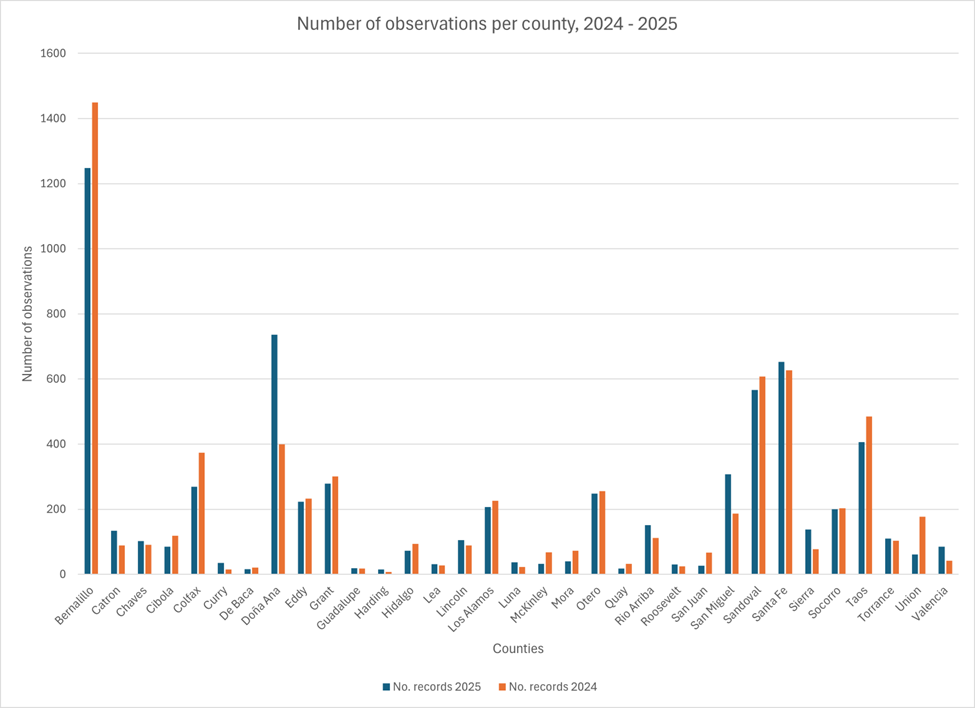
These two graphs show a lot of similarities between 2024 and 2025.
Finally, here’s the seasonal distribution of observations:
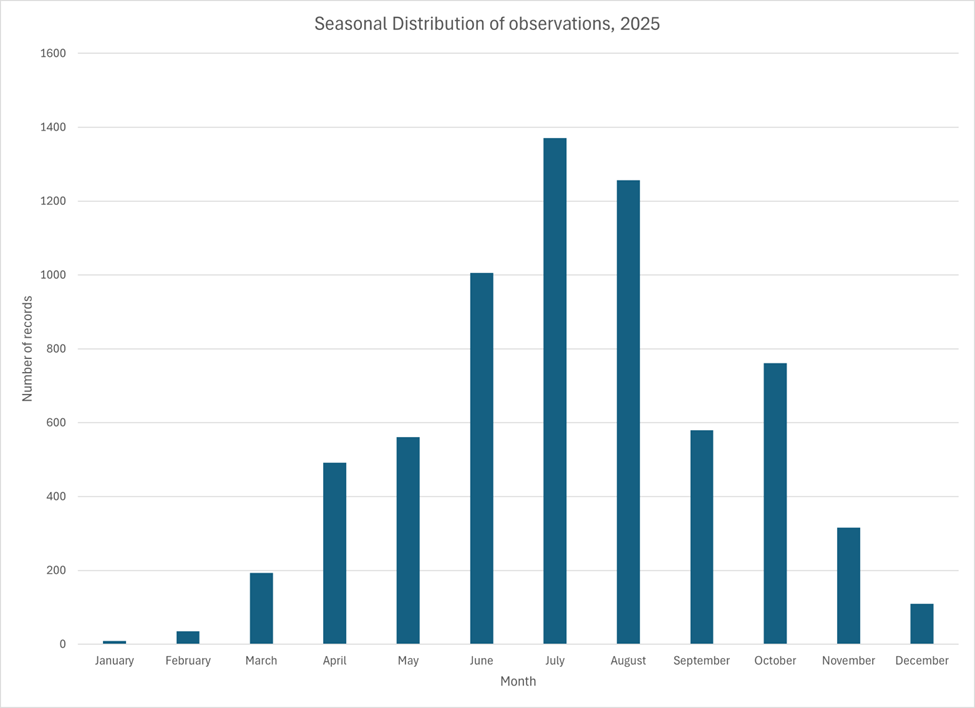
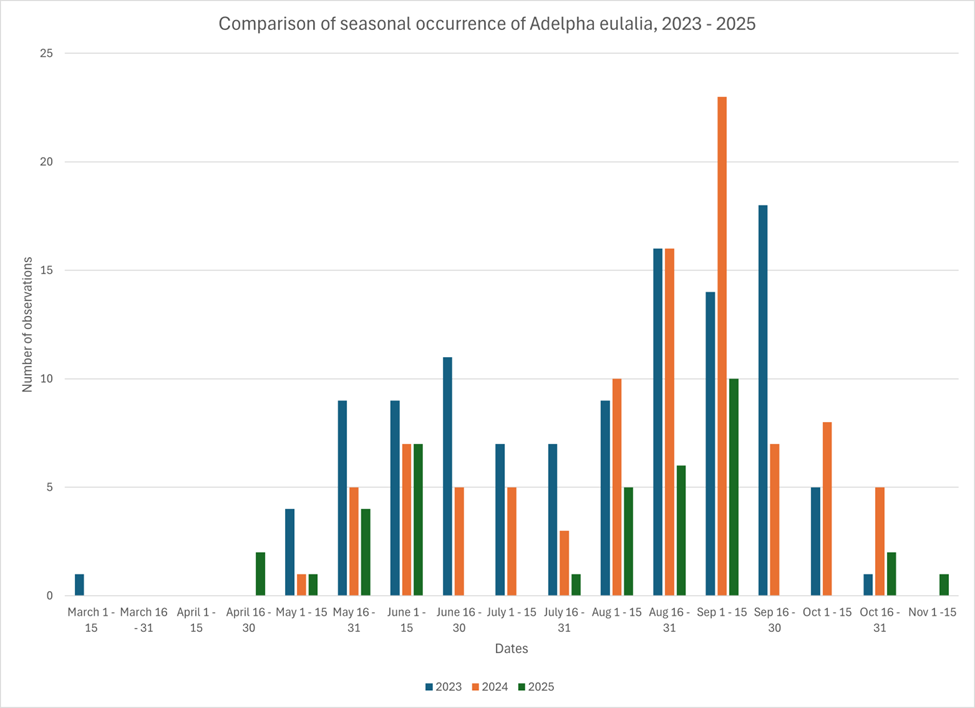
No one will be terribly surprised at this distribution of observations. Followers of Steves’s blog recognize that 2025 set a lot of late records for various species, especially in Doña Ana County. The data I’ve abstracted allows Steve and I to visualize the seasonal distribution of many species. Since I used Adelpha eulalia as an example last year, here that species is below, comparing seasonal occurrence in 2023, 2024, and 2025. Still looks an awful lot like 2 generations.
Thanks to all for your valuable contributions. On a personal note, back in the 1950s and early 60s, there were very few folks making observations that were available to everyone. Until Dick Holland arrived in 1964, I was the only New Mexico butterflying member of the Lepidopterists’ Society. It feels very nice to see how far we’ve come, and to know there is still so much left to be seen! Here’s to a great 2026!
Adios to “Mexican Metalmark,” by Steve Cary. In February, Zhang et al (2026)* completed and published their long-awaited genomic study of metalmarks in the Apodemia mormo complex, which for New Mexico has included Mormon Metalmark, Dury’s Metalmark, and Mexican Metalmark. Their work shows that Mormon and Dury’s each with green eyes, remain largely unchanged in terms of taxonomy and nomenclature. But significantly, “Mexican Metalmark (Apodemia mejicanus)” is no longer the name we apply to gray-eyed metalmarks from the Bootheel to Raton and many places in between. Zhang et al., I think appropriately, restricted the name “mejicanus” to bugs in a small geographic area in northern Mexico (its type locality) reaching into south-central Arizona. Over several decades, Apodemia mejicanus had become a catch-all taxon for metalmarks that did not fit well with any other named entity. Truth be told, most New Mexico metalmarks tossed into that bucket since the 1960s look nothing like actual mejicanus from its type locality, so I think this was a good decision by the authors.
Accepting that decision leaves only one other name available from within our gray-eyed metalmarks: pueblo (J. Scott, 1998). That was the name James Scott gave to the metalmark he described as living in the Colorado Rocky Mountain Front Range, but he offered it as a subspecies of mejicanus, which it can longer be per Zhang e al. (2026). With support from their DNA analyses, those authors elevated the status of “pueblo” to a full species. Univoltine populations living at middle elevations in the Sangre de Cristos, with bright orange veins on the hindwing underside and using Eriogonum jamesii v. jamesii for larval food, which we had been calling Apodemia mejicanus pueblo, are now simply Apodemia pueblo, which seems proper. Populations in the Sacramentos, formerly of uncertain affinity, are now recognized as a new local subspecies: Apodemia pueblo sacramento Grishin. In my opinion, the geography, biology and ecology of mescalero are consistent with subspecies status under A. pueblo.
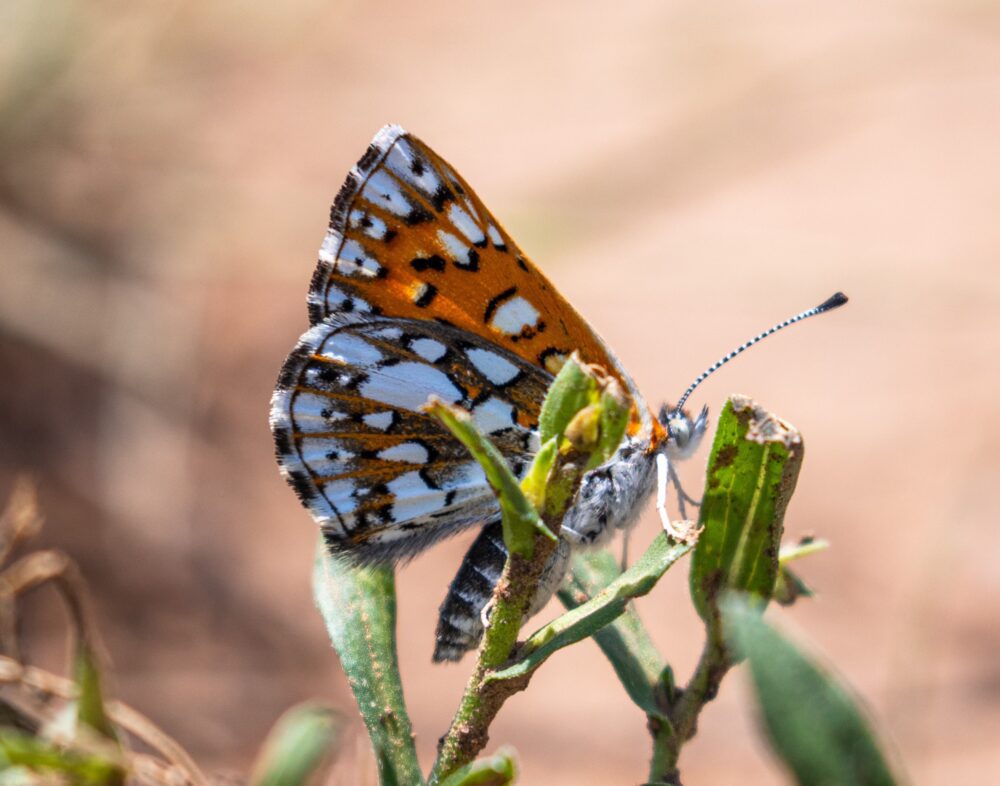
Those authors also suggested that A. pueblo have the common English name of “Pueblo Metalmark.” No doubt Jim Scott chose that name to recognize the City of Pueblo near the Colorado type locality. Using the scientific name as the common name does mean one less name to remember. But the term “pueblo” has complicated meanings and uses in New Mexico, including some 19 independent Pueblo nations, none of which are near where this metalmark lives. Instead, I suggest we call this “Front Range Metalmark” because that accurately describes where it occurs in Colorado and New Mexico. Even the Sacramento Mountains complex represents the mountain “front” at that latitude when viewed from the Great Plains. Common names are merely suggestions anyway, so let’s suggest “Front Range Metalmark.”
That takes care of some of the gray-eyed metalmarks in NM, but many other populations remain in central southern and west NM, not to mention Arizona and Texas. Genomics analyses by Zhang et al. came to the conclusion that all these other populations, formerly mejicanus, comprised a distinct species which they named apache Grishin. Most of you who once lived in the neighborhood of A. mejicanus now find yourselves neighbors to Apodemia apache Grishin – same neighbors, new moniker. This seems like a terrific name given that the range of this metalmark closely matches the larger Apache homelands. From Albuquerque to Las Cruces, from Lordsburg to Reserve, this is now your gray-eyed metalmark.
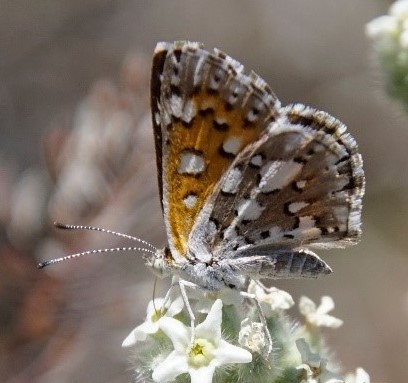
But life will not be that straightforward, eh? Zhang et al. (2026) found that the genetic variation within Apache Metalmark clustered into four entities which they deemed to be subspecies. Apodemia apache apache, the nominate subspecies, occurs in the highlands of eastern AZ and western NM. Subspecies Apodemia apache rufa lives in Cochise County, AZ, and southern Hidalgo Co., NM, and no doubt south from there. Trans-Pecos Texas has subspecies Apodemia apache texana. The Rio Grande Rift in central NM, from Albuquerque south to El Paso, has subspecies Apodemia apache riftoria (love that name) and allegedly this is only east of the rift. In a comprehensive study having the scope and magnitude of Zhang et al. (2026) – all of western North America, 8 species and >20 subspecies – some details will invariably need to be refined or worked out down the road. If one of their decisions causes you to wrinkle your brown or scratch your head, then consider it a question to investigate. Here are some things that came into my head: (1) they used no samples from Luna County; (2) this is a lot of subspecies between the Chiricahuas and the Davis Mountains; (3) why east of the Rift and not west? (4) does A. a. texana also occur in southern Otero and Eddy counties in adjacent NM? I consider these questions to be opportunities for us all to explore, investigate, try to fill in some geographic holes and maybe gain more understanding of the details of our Apache Metalmark. At least we are no longer scratching our heads at the species level, which is a huge upgrade.
* Zhang, Jing; Cong, Qian; Shen, Jinhui; Song, Leina; and Grishin, Nick V., “A Taxonomic Overview of the Apodemia mormo Complex from a Genomic Perspective” (2026). The Taxonomic Report of the International Lepidoptera Survey. 103.
https://digitalcommons.unl.edu/taxrpt/103
A New Angle on Hairstreak False Heads, by Steve Cary. Most hairstreak butterflies perch with wings closed, but that’s cool because undersides thus revealed are often quite attractive and good bait for photographers like me. When you see enough hairstreaks, you learn to appreciate all the decorations at the back end of the hindwing (tails, spots, tabs, flaps, etc.), which they sometimes put in motion to add to the illusion. We all have read the theory (well-reasoned, I think) that all that monkey business has been naturally selected because it tricks bird predators into thinking “head” and attacking that part, which is dispensable, rather than the actual head, which is not.
I have been taking that false head for granted – thought I knew everything – but now I am not so sure. Have you ever looked closely and noticed that some of the hindwing back-end shenanigans are bent or curled, not in the same plane as the wings? In 45 years of trying to get my lens perfectly parallel to the wing surface for the perfect broadside hairstreak photo, I had disdain for those aggravating “imperfections” as they wiggled in and out of the focal plane. Well, my actual eyes have been opened. Check out the photos below.
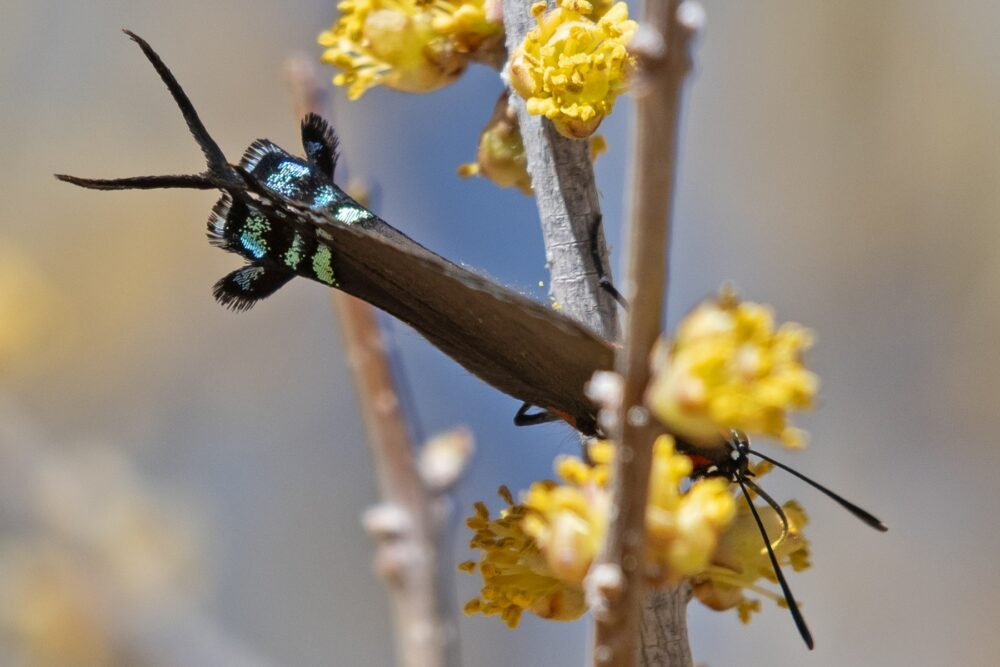
Dave’s photo above is a prize. The two black tails are close copies of the actual antennae, even their angle. Then the blue and green parts jutting out to the sides almost look like fuzzy fish fins. The actual head is hidden in a flower cluster.
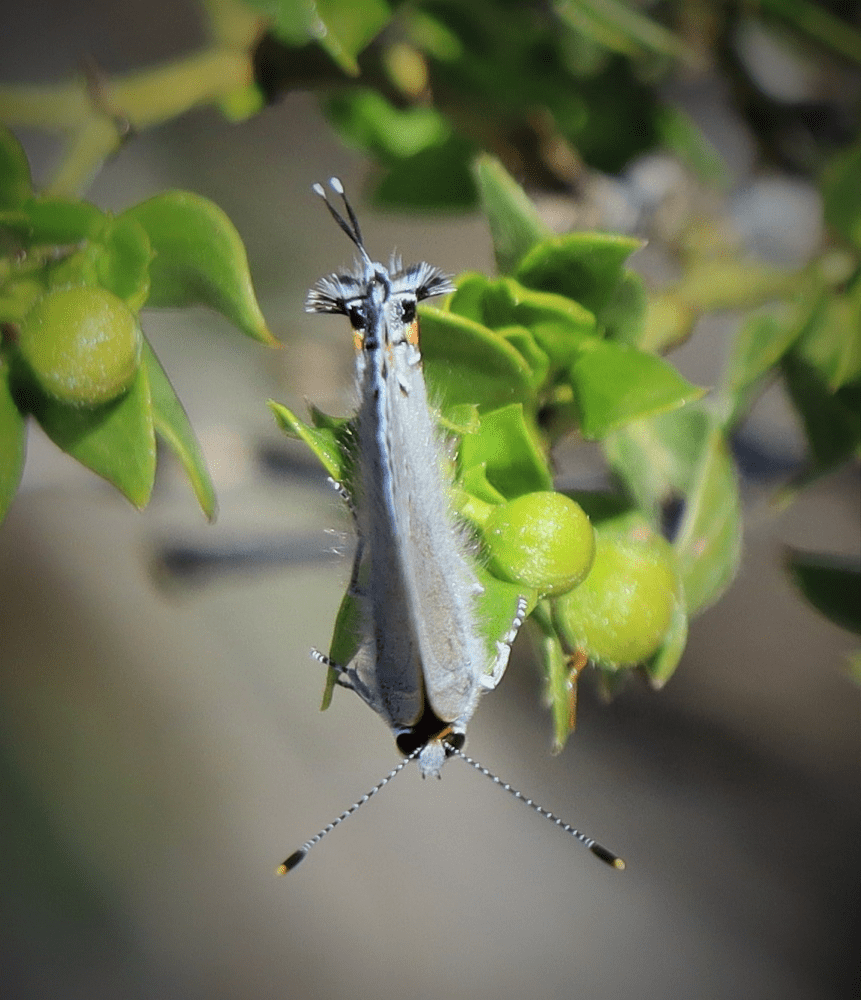
Jim’s image shows that Gray Hairstreak’s false head is almost an exact duplicate of its actual head. Antennas (real and fake) have light club ends. The fuzzy wing panels curling at right angles to the body have black “eyes” and even a bit of orange, just like the real head. If you were a hungry bird, which end would you go for? The false head does not have to work every time. If it only works 50% of the time, that’s 50% of the Gray Hairstreaks that are still out there doing their thing.
I do not have any shots like these in my personal collection, so this reinvigorates my photo goals for this and future years. Now I am motivated to go back out, find all NM’s hairstreaks and photograph each from above and see them in a whole new light. I challenge you to join me in that effort. For each species I will include your best photos in future blogs and also in Butterflies of New Mexico. I’m feeling much more excited about 2026!
Happy hunting this spring!
Great blog post, thanks! This has me excited about 2026. I find many interesting butterflies in my backyard in Eldorado at Santa Fe. Many are drawn to flowering mint that takes over my raised vegetable beds each summer.
thank you, Patty. best wishes for the 2026 butterfly season.
Hi Steve and Mike, Thanks for another fine production of New Mexico happenings. Two comments about Apodemia pueblo: The author in his original description only stated, “This ssp. resembles mejicanus (Behr)…” (James Scott, Papilio (New Series) #11, Feb. 20, 1998, p. 4). Pueblo was not at all “offered” as a subspecies of mejicanus by the author as you wrote. As for a common name, I suggest “The Puebloan Metalmark.” Will that satisfy the fact there are various cultures associated with the Pueblo Indians and relatives? The type locality is actually in El Paso County, Colorado, probably twenty to thirty miles north of the southern Colorado town of Pueblo that is in Pueblo, County! I have found it south and west of Pueblo in that county proper. I was going to write you (Steve) about the eye color of pueblo. When we went up the road to Rio Chiquito in 2023 on our A. cybele carpenterii quest, we stopped along that one hillside with E. jamesii. I vouchered two male pueblo and I intended to note the eye color for the data labels. When the Zhang paper appeared I looked at the labels and the eye color was not noted as I intended. I swore they were grayish and not green…and your blog here confirmed my memory…so thanks for the thoroughly helpful review.
Both of you and all of the blog contributors take care, Mike
Mike, thanks a bunch for your sharing your sharp memory with regard to A. pueblo. I should have consulted you before writing anything. I thought it was great that Zhang et al. factored eye color into their analyses. I struggle with metalmark wing characters, but eye color (on live individuals or photos) is very distinctive, very straightforward, the way I like it. I also thought they did well by A. mormo and A. pueblo in the San Luis Valley by naming them but acknowledging they are only weakly differentiated, and the likelihood of introgression. Definitely a good idea to note eye color on labels, since they all seem to lose that color at some point after death.
I do not go out very much as of now, and I still follow the blog, so do NOT remove me from this email list! Love reading!