
By Selvi Viswanathan
Aspen trees grow all the time even in Winter despite being deciduous trees. Beneath their thin white outer bark layer, there’s a thin green photosynthetic layer that allows the tree to create sugar and grow when other deciduous trees.
Their nickname? “Quakies” because their stem is perpendicular to the leaf, acting as pivot and causing the leaf to twist and flutter, even in the slightest breeze.
Common name: (populus tremuloides)
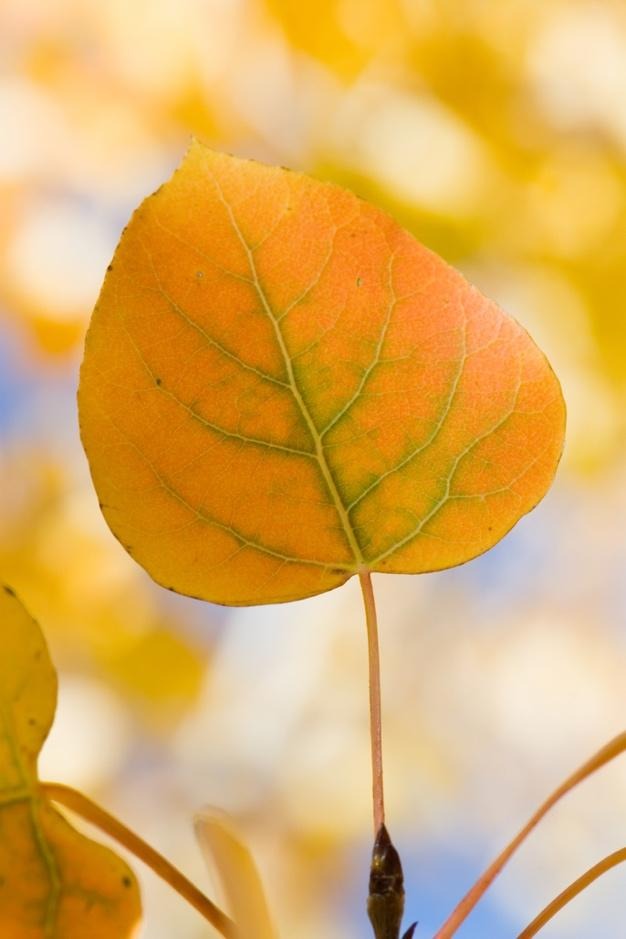
Benefits of the 90-Degrees:
1. Reduces stress: The trembling motion allows the leaves to pivot and protects the tree from damage during high winds.
2. Increases Photosynthesis: The fluttering allows more sunlight to reach the inner leaves and it also enables in turn to photosynthesis more effectively on both sides.
3. Pest Control: The constant erratic movement may help prevent insects from settling on the leaves.
What is special about Aspen Trees?
Aspen trees are special for being massive, interconnected clones. These clonal colonies a strand of Aspens is often one giant organism, a single genetic clone connected by a vast underground root system making one of the world’s oldest and heaviest living things. Aspens grow rapidly producing softwood and abundant sugar making them crucial for easily succession after disturbance like fires.
Los Alamos means “The Aspens.” When we moved into our home on Barranca Mesa in 1985, I wanted to add a few things to our yard, so in 1986 we planted three aspens in the front. Now, nearly 40 years later, those original trees have matured, and we’ve had to manage the saplings that keep popping up. The one right in front of our porch has grown especially beautifully. In the fall, I can see it perfectly from the upstairs window in our prayer room; its golden leaves fill the whole space with a warm, glowing light.
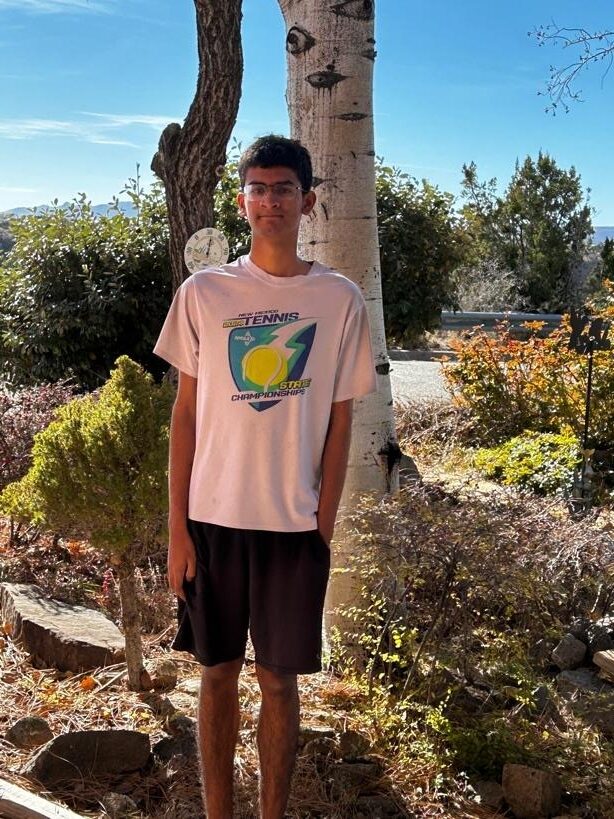
Here’s a picture of our grandson Aditya who is 17 years old and kindly agreed to pose next to our aspens for me!
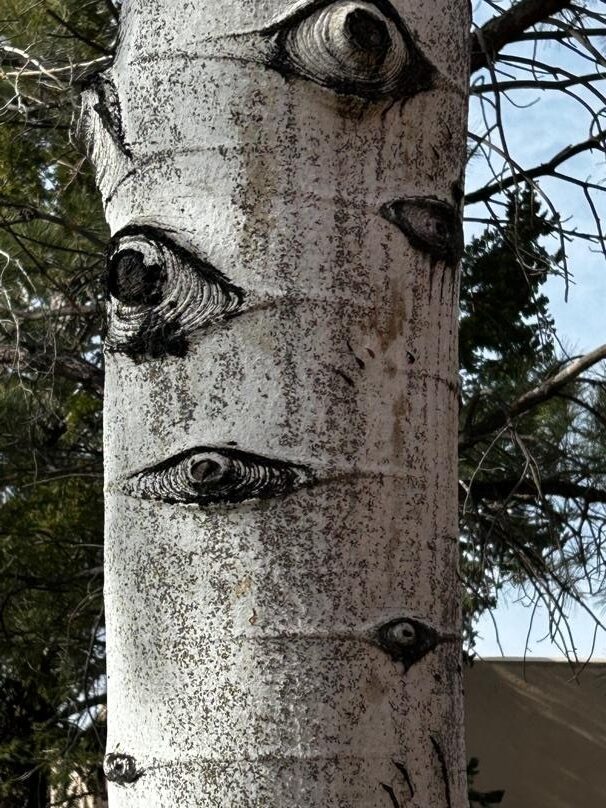
I recently learned that aspens have the remarkable ability to prune themselves. As the tree grows taller and reaches for more sunlight, the lower branches naturally die back and drop off. I’ve started noticing the little twigs collecting beneath ours.
Interesting facts:
1. The name: Aspen is a Greek name, and it means Shield. Symbolic Protection.
2. Aspens can also used as particle board and light construction due to thin light wood.
3. The trees serve wildlife as it provides vital nutrient-rich forage for elk, and deer.
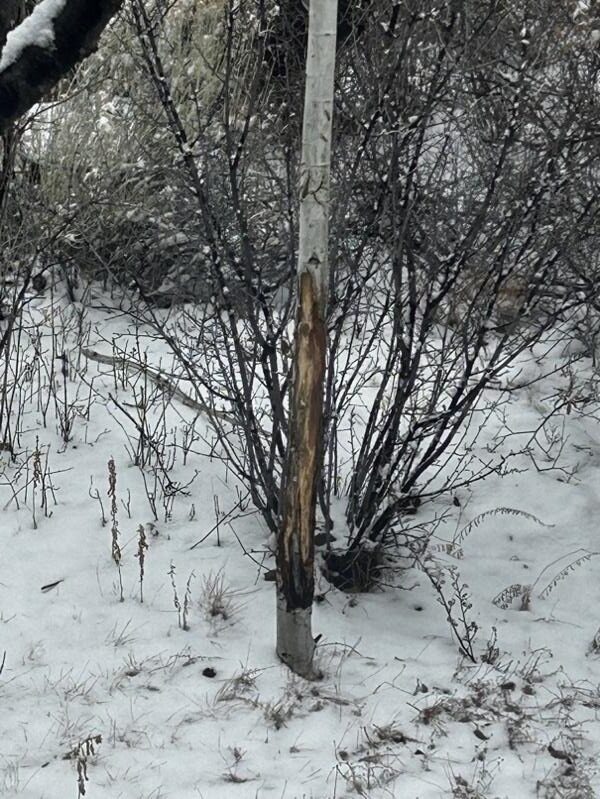
4. Aspens grow rapidly producing soft wood and abundant sugar making them crucial for early succession after disturbance like fires.
5. Popular in landscaping recreating features with beautiful Fall Colors.
6. Aspens can be used to create matches, tongue depressions, paper, and popsicle sticks.
A very educative article. The photographs are beautiful and the eyes of the tree seem to benignly look after the residents it protects.
Thank you very much. Yes I feel the same you mentioned about keeping an eye on us.
Very interesting, with facts I didn’t know: especially the reason and benefits of quaking and the ability for self-pruning! Thanks for explaining so much about aspens.
Thank you Becky. I value your input very much.
Always nice to learn.
I, too, was struck by the eye pattern of the bark and had not know it could self-prune. I guess that’s why it’s so lovely to ramble under them in the autumn. Nice!
Thank you very much. Self pruning depicting the scars like out eyes really amazing what made me to write.
Interesting facts about aspens, much of which I did not know. The photos are lovely. Thank you for sharing
Dear Mathy ! Thank you very much. Right in our yard seeing these self pruned scars like our eyes is really nice.
JAYASAHREE MOHANRAJ
TUESDAY, MARCH 31,2026 at 3.31 PM
Very interesting information about Aspen trees. I have never seen one. But it reminds of the coconut trees in India and the rings that form when the fronds fall. Very beautiful. Also, it reminds me of the zebras I saw in the African wildlife safari I had recently. The guide told us that each zebra has a distinct pattern of stripes. Wonder if each Aspen has a distinct pattern of the eyes.
Thank you for the lovely photos , especially the one with Aditya which gave a lively touch to the photo.
Thank you Jayashree . It is interesting about coconut trees you have mentioned.
Selvi, thank you for your very informative article on one of my favorite trees. I too didn’t know that aspens were self pruning and that their name is Greek! I especially love the beautiful green of the trees in the Spring and the yellow, orange, and sometimes pink or red too in the Fall.
Although it is better not to mark their white bark, lonely sheepherders here in New Mexico and some other states carved their names, village, and the date and sometimes pictures on the bark.
I see it wonderful. Thank you for trying and it is important for me to hear your thoughts I value!
Very interesting article and the picture is very nice
The eyes really looks fascinating. The tree is maintained for 40 years at home is great news.
Thank you . It is nice to see your yhouhhys. Yes this tree is this one we see the scars as ryes and right in front of the house. I see whenever I am at front door through glass.
I did not realize that Los Alamos means the aspens! I learned a lot of new facts about these special trees. Thanks for sharing.
Yes. Thaila that is what made me to plant these trees! I loved Fall colors in East Coast when lived. So Aspens here we see in its glory with golden colors!
Selvi, I just love this! Aspens are one of my favorite trees. When we were children I remember my Dad calling them “quakies”. I thought this was his special name for them…but now I learn from you that this is a common nickname. I love the fall colors…on Los Pueblos, in Los Alamos, and especially up at the ski hill! I remember one year when the tent caterpillars had decimated the leaves up at the Santa Fe Ski Basin. I was riding my bike up there when Ian was having his physical therapy at St. Vincent. The road was covered with squashed caterpillars (from the cars) and the trees were bare. I was told they possibly would grow more leaves? Also, I’ve sometimes seen old “arborglyphs” in the backcountry of NM and CO. (This is when letters are carved in the thin bark.). You might see carvings from the 1800’s…possibly by the Basque herders who were watching the sheep and cattle.). Thank you, Selvi , for writing this.
Dear Darien
Thank you very much for writing about your experiences of Aspens.
Yvonne just e mailed me reading your posting!
Selvi,
Thank you for your article. I did not know that aspen trees could photosynthesize without leaves. That is fascinating! I called them “money trees” when I was a child because of the tinkling sound of the leaves in the breeze. They are wonderful!
Thank you Barbara . I was surprised too only green bark helped.
So you had this name Money trees is good too.