
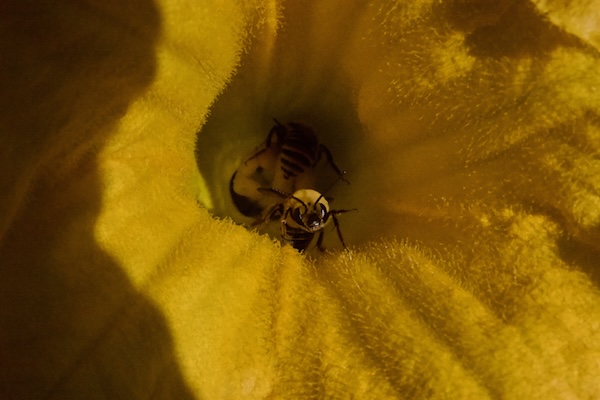
Do you grow squash in your garden? If yes, you might be lucky enough to catch a glimpse of hardworking squash bees pollinating your summer and winter squash, or when you enjoy pumpkin season, you know squash bees were busy earlier in the season!
“Squash bee” refers to two genera in the tribe Eucerini, Peponapis and Xenoglossa, and all are wild bees native to North and South America. They specialize in pollinating the flowers of the Cucurbita genus, including summer squash, winter squash, and some gourds, relying almost exclusively on squash and gourd pollen to feed their young. Since a squash fruit (zucchini, pumpkin, etc.) will not form unless its flower is pollinated with pollen from another flower of the same type, an insect pollinator– most likely a squash bee in this case– had to visit multiple squash flowers, spreading pollen in its wake. Interestingly, while cucumbers and melons are in the same family as squash, squash bees do not tend to pollinate their flowers.
Squash bees are slightly larger and bulkier than honey bees, and are hairy with long antennae and round faces. They are solitary, meaning they do not form colonies. After emerging from her nest and mating in the spring, a female squash bee will dig a tunnel into sandy or well drained soils, often in the middle of a squash patch. In the underground tunnel, she makes individual nests and lays an egg in each, leaving a stash of squash pollen for the larvae to feed on once they hatch. Adult squash bees are only active for several weeks during the summer months when pollen is abundant in squash blossoms. After provisioning her nests and laying eggs, the female bee dies, but her offspring will spend the rest of the year underground in their nests developing into next season’s adult bees. Male and female squash bees visit open squash blossoms in the morning when they’re in full bloom, and males can be found napping inside closed squash blossoms during the daytime.
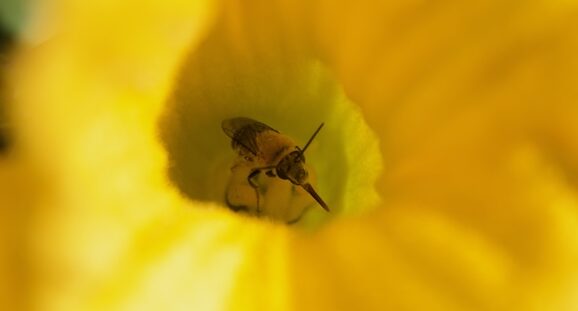
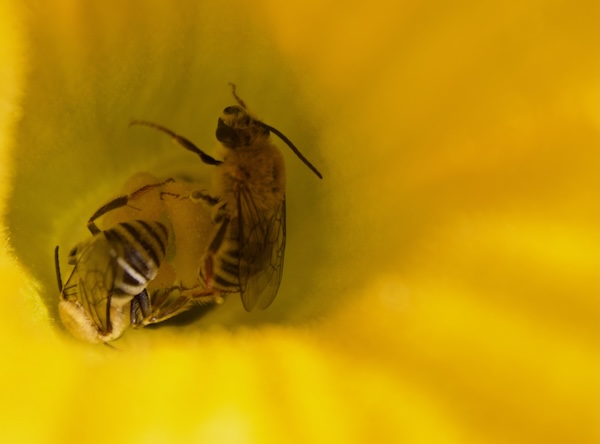
Since squash bees rely on squash pollen, their relationship with humans in North America is historically intertwined. As the range of squash plants expanded with their domestication and cultivation by Indigenous peoples, squash bees followed human migration across the land. There is some evidence that squash bee populations are not declining as rapidly as other wild, native bees due to the modern increase in large-scale agriculture involving Cucurbita squash, but results of studies on squash bees are mixed. Pesticide use is still intensely problematic and negatively impacts all pollinator populations, and squash bees are most likely affected like many other native bees.
As the season for pumpkins, gourds and winter squash ripens, don’t forget to give thanks for these remarkable native pollinators. Your visit to a pumpkin patch and your spooky jack-o-lantern was made possible by the intrepid squash bee!
Britton Donharl is the Bee City Los Alamos Coordinator.