
© Steve Cary, October 3, 2026
We have a great feature today, as the New Mexico Butterfly Monitoring Network recently issued its 5-year report. I’m saving that for the middle of this post so we can first chat a bit about our jaw-dropping weather extremes. But even before that, check out this program shared by Tom Taylor https://www.nationalgeographic.com/animals/article/animals-butterflies-migrations-europe-africa
and this article shared by Brian Miller: https://www.essex.ac.uk/news/2026/09/30/butterflies-use-optical-illusions-to-dodge-predators
and this video by New Hampshire friends Paula and Tom (we “New” states have to stick together):
Larva of Eastern Tiger Swallowtail (Pterourus glaucus), ready to pupate, does its best snake imitation.
What a summer it has been for our weather! Higher than normal temperatures and massive, long-term, widespread drought virtually statewide. We walked about like grim-faced zombies, seeing brown everywhere and few living things, hoping for rain. Here is Kelly Ricks’ take from Des Moines in far northern Union County:
I completed my worst ever NMBMN survey at Sugarite on August 13th. I saw 8, yes EIGHT, TOTAL butterflies. Not species: individuals. At Sugarite?!? Including “incidentals” I MAY have seen 5 species, but if the “unidentified blue” I observed was a Marine Blue (which is likely), then the species total drops to 4. During this same timeframe last year (8/8/25) I tallied 38 individuals within 14 taxa. Several I was unable to pare all the way down to species, but it’s still a good indication of number and diversity.
The last NMBMN survey on Capulin’s rim (8/20) yielded ONE single Black Swallowtail. It was unnerving. Due to being gone . . . I don’t have an August Rim survey, but for comparison, on 7/18/25 I tallied 43 individuals in 10 taxa, and on 9/26/25 I tallied 9 individuals of 5 taxa (slim…but it was later in the season, so…). The Boca Trail route has had a few more in number, but it’s hard to get excited when the numbers of individuals AND species observed is still below 10.
We have of course had an unusually hot summer. I haven’t dug into the actual numbers, but we have hovered between the high 80s and high 90s for much longer than I recall experiencing in the 7 years I’ve been here. And, even more telling perhaps, it has not been cooling down at night. That’s something I’ve always loved about this area: no matter how hot it is in the daytime, we could almost always plan to cool down the house with open windows once the sun set. This year we’ve had to run our AC more than we ever have in the past.
One positive observation is that I’ve seen more Monarchs passing through than in the past. In previous years I’ve casually noted a couple every few days, but lately, I’ve seen 2-4 travelling through on most days. They never land, so I haven’t been able to submit any official sightings, but it’s been nice to see a slight pickup nonetheless.
So there you go. I hope our population is indeed prepared to handle a tough year like this and bounce back.
[thanks, Kelly!]
Then in a major switcheroo, it rained and rained. Did you survive our recent Noachian deluge. The amateur rain gage in my Santa Fe backyard tallied more than 7 inches of rain from 9/15 through 10/1. That’s more than I’ve measured in some complete years. Over 15 years of records, my previous wettest month was less than 5 inches. I hope you all survived and managed to get through it without serious consequences. How much precipitation did you get during those few weeks of intense, daily, relentless monsoon weather? Now we are drying out all our drenched yards, fording flooded creeks, repairing leaky roofs and waiting for mud to solidify. Will those recent rains make difference for our butterflies? We will find out over the next several months.
Peggy Barroll shared this excellent analysis of that stretch of wet weather, including some insights on the “Mega” El Nino issue: https://liafailwallaceterrycjr.substack.com/p/floods-in-new-mexico-the-el-nino?utm_source=share&utm_medium=android&r=1281us&fbclid=Iwb21leAUxRYZjbGNrBTFFQGV4dG4DYWVtAjExAHBkb2YFc3J0YwZhcHBfaWQMMzUwNjg1NTMxNzI4AAEebJ7RUE7vElzJvR22OSLIiqlo1LU-0G137f1TIe6l8vas62lo61bN9J12U1E_aem_OSrizgDw9_Gry93VpXEDVw&utm_id=97758_v0_s00_e0_tv4_a1dennhbc06vzc
It’s a long article by a climate/weather professional, well worth reading to the end.
The New Mexico Butterfly Monitoring Network 2020-2025 Five-year Report (this summary prepared by Anna Walker and Quin Baine)
Butterfliers know better than anyone that in some years, butterflies seem to be everywhere in high abundance all over gardens, parks, puddles and hiking trails, while in other years even common species seem few and far between. With all we know about large-scale trends in overall insect abundance (known by some as the “insect apocalypse”) and with increasing variability in precipitation, temperature and severe weather, these year-to-year patterns become mysterious. Are these fluctuations simply normal boom-and-bust of butterfly populations, or are some species actually on a directional trend becoming less common over time? Are butterflies in general decreasing? Are some species at risk of extinction? These questions, though important especially in the face of ongoing drought conditions in our region, can’t be answered through haphazard and anecdotal observations alone. To understand what patterns are occurring, we need to watch butterflies in the same locations, year after year, season after season.
The way to do this is through long-term monitoring. The New Mexico Butterfly Monitoring Network (NMBMN) was started in 2020 as a regional monitoring program of the North American Butterfly Monitoring Network, which seeks to coordinate localized programs with standardized protocols and data collection practices for long-term tracking of butterfly species. By following these standards, data collected by the NMBMN can be shared and compared with monitoring data from across the continent, providing robust evidence for detecting changes in species diversity and abundance, as well as shifts in geographic distributions. Monitors for NMBMN are volunteers that dedicate about an hour per survey, at least eight times per flight season, to count and identify all of the species that occur on a pre-assigned static route. These monitors return to the same route every time, allowing for familiarity with local butterfly taxa, recognition of habitat changes, and consistency in counts across surveys.
We are pleased to share the results of this incredible monitoring effort from the first five years of the NMBMN program in a full report, accessible here: https://thebutterflynetwork.org/sites/default/files/PB-NMBMP-Five-Year-Report-2025-Final.pdf. While five seasons is not quite enough time to detect statistically significant trends, some patterns are starting to emerge, including information on how butterflies might be responding to changing conditions across the state, and we summarize some of the findings for you here!
Findings of the NMBMN 2020-2025
Since the NMBMN began, 74 volunteer monitors and recorders have surveyed 41 monitoring routes across the state. Together, they have dedicated more than 1,700 hours to conducting 1,643 surveys, documenting 38,705 individual butterflies across 163 species. Routes occur in five of New Mexico’s eight ecoregions, with most routes occurring near population centers of Albuquerque and Santa Fe.
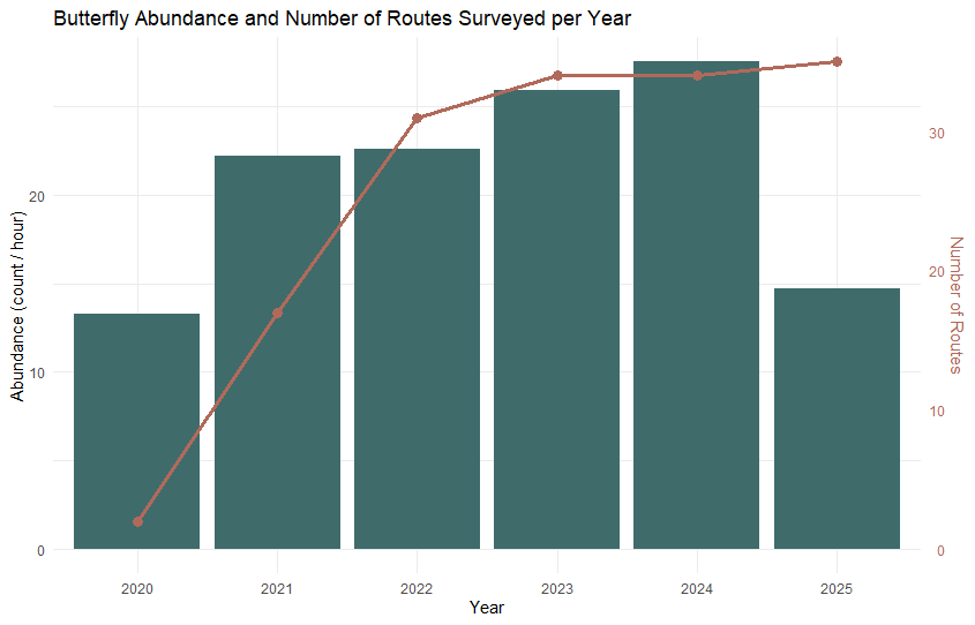
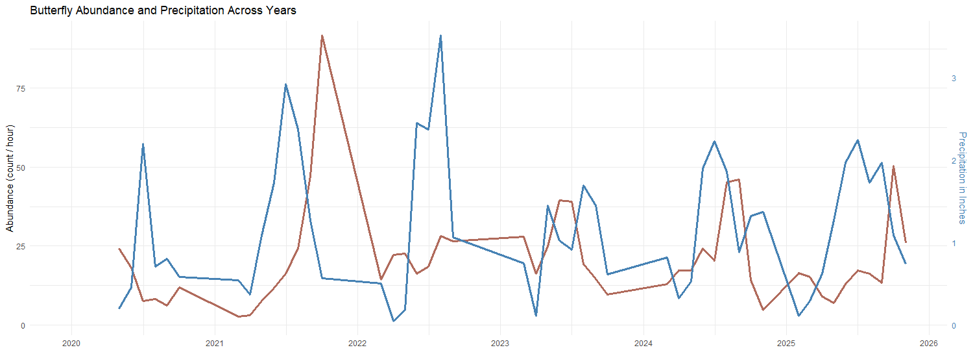
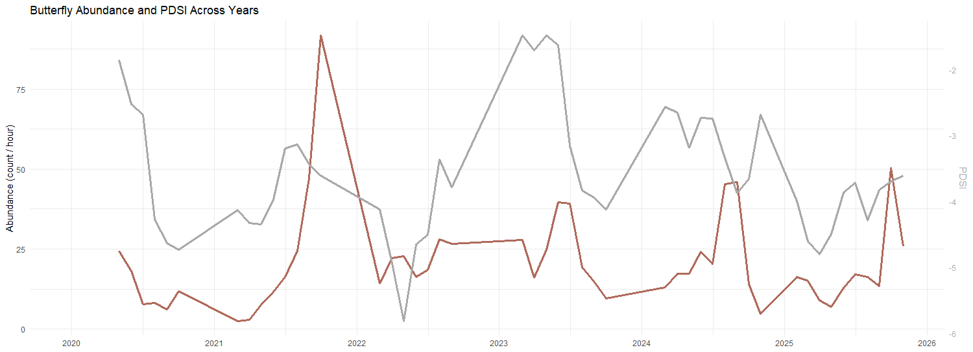
Using an index of abundance (count per hour spent surveying), we found that butterflies increased with the number of routes until 2025, when abundance dropped to only 65% of the average of the previous years. However, abundance was not steady across the seasons, with some years experiencing more extreme highs-and-lows, and some more steady. One reason for this might be climate correlates; for example precipitation in our region has been variable year-to-year. We find that statewide monthly precipitation peaks, in each year except for 2022, are followed closely (~3 months later) by a relatively similar butterfly abundance peak. The exception in 2022 might be explained by the severity of drought (measured by Palmer Drought Severity Index) during that winter preceding the summer precipitation.
Abundance was very different across regions, with the highest totals generally from the Pinos Altos and Black Ranges, which saw some events of extreme high abundance of puddling Azures and Marine Blues. Valle de Oro National Wildlife Refuge route also saw a boom in Orange and Clouded Sulfurs one year, resulting in very high total numbers. In general, routes in montane areas and/or in proximity to water sources such as rivers, streams, or wetlands boast the most diversity and abundance of butterflies.
The most abundant species was the Echo Azure, with a total of 3,844 observations. Other “boom” species include the Red-bordered Satyr, Painted Crescent, and American Snout. The most widespread species that occur across the highest number of routes include the Checkered White, Mourning Cloak, and Dainty Sulfur. Thirteen species were only observed once across all surveys, more likely due to habitat specialization, range edge, or identification difficulties due to similarity to more common species, rather than rarity.
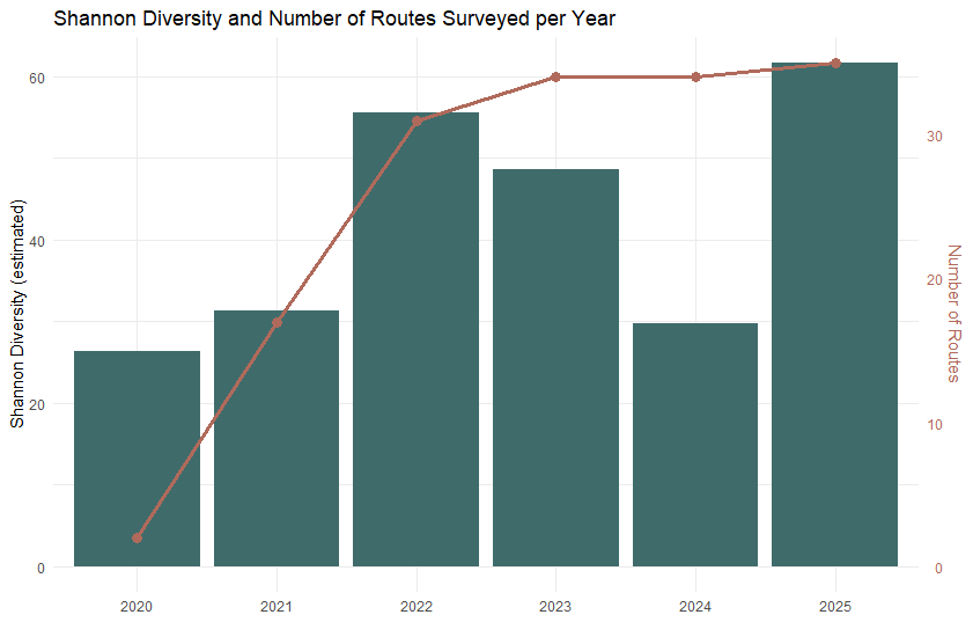
Diversity was quite variable across the period of 2020-2025, but in almost the opposite pattern as abundance, with the highest diversity in 2025. This was the lowest abundance year, apart from the first year when only two routes were surveyed. This may indicate that abundance patterns are strongly influenced by species with giant population booms – more abundance, but fewer species.
Also included in the full report are summaries of the abundance, monthly seasonality, photos, and species lists for each individual route. This allows for these patterns to be appreciated across different ecoregions and habitat types, and highlights what monitors can look for in future years for their respective routes.
Future goals of the NMBMN
While we are proud of the first five years, there remains a lot of room to grow. Our primary target in the next five years is expansion of NMBMN geographic coverage to get better representation of the state through inclusion of routes in new ecoregions and habitat types. Five areas have been identified as high priority for route establishment:
- The High Plains ecoregion
- The Sacramento, Capitan, and White Mountains
- Southern Rockies of Taos and Rio Arriba Counties
- The Colorado Plateau ecoregion
- The Mesilla Valley
- The Madrean Archipelago ecoregion
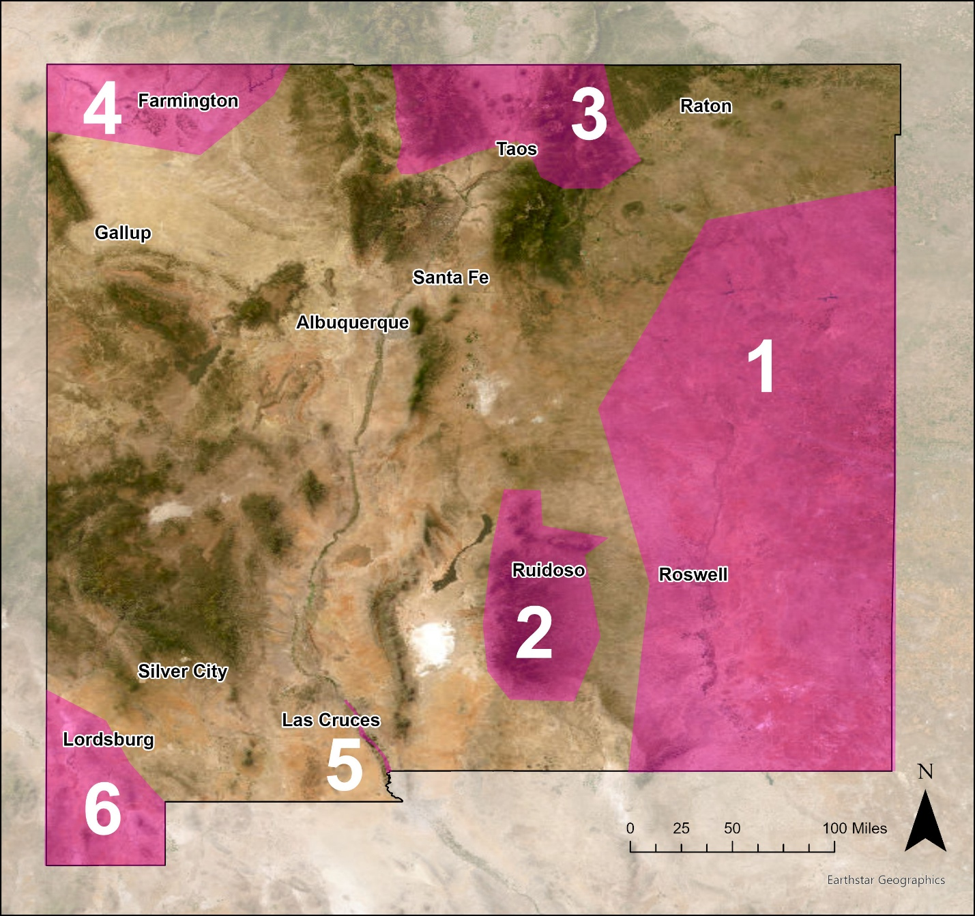
To achieve this target, we need to find willing volunteers that live in these areas so they can regularly perform surveys. Focused recruitment may be necessary.
Another target is to set up new routes where Species of Greatest Conservation Need (SGCN) butterflies may occur, to increase chances of collecting new observation data for these poorly known, rare, or threatened species. We also aim to complement species lists per route by collecting plant inventories from each route, which can inform host plant and nectar plant resources and therefore potential restoration tools for the future.
Ways to get involved
Become a monitor: We are always accepting new volunteers who are willing and able to take on the responsibility of regular surveys. While spots often open up on existing routes, our goals to set up new routes for better geographic and taxonomic coverage would be best served by volunteers that live in under-represented areas. Contact Anna Walker (redlistinverts@bioparksociety.org) if you think you could be a good monitor and want to contribute.
Use our data: The ultimate purpose of collecting long-term count data is to enable more and higher-quality research on butterfly population trends. Read the report to see which species are represented in our dataset. Contact Anna Walker (redlistinverts@bioparksociety.org) if you are interested in the whole dataset.
Support butterfly conservation: Easy day-to-day activities like growing native plants, limiting use of pesticides, and staying on trails when hiking can all contribute to the health of butterfly ecosystems.
Photos:
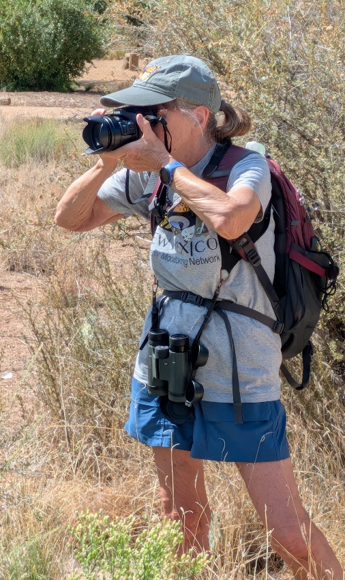
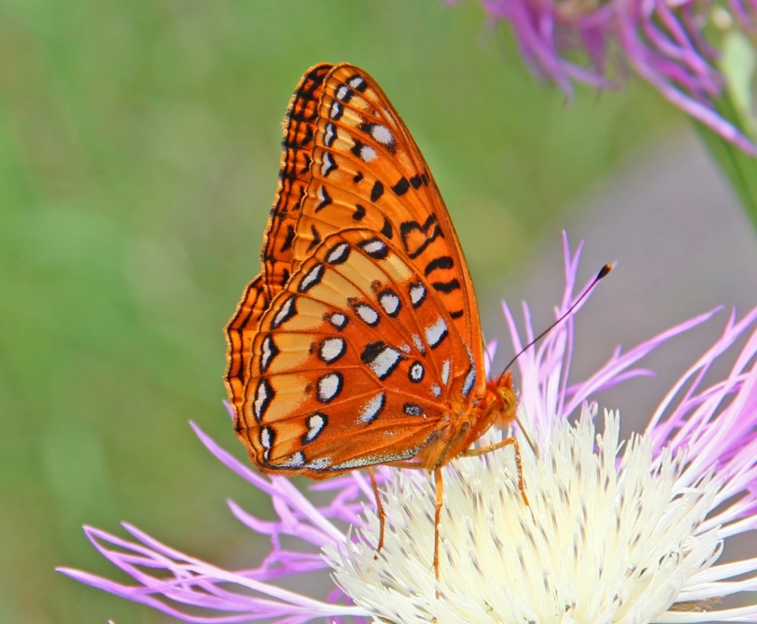
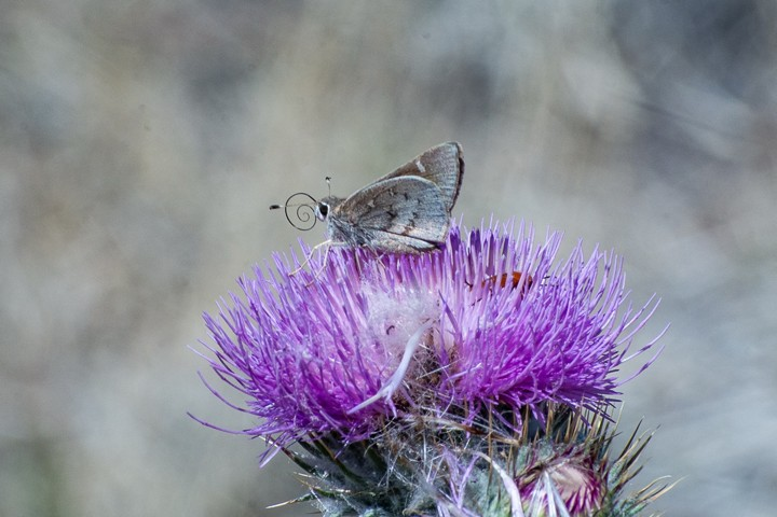
[Anna, thank you so much for initiating this program and carrying it out so professionally and successfully for more than five years. It truly is an excellent way for butterflyers to conduct meaningful monitoring and produce scientifically valuable data. Looking forward, as years accumulate on each monitoring transect, NMBMN will continue to be a major contributor to butterfly knowledge, research and conservation in New Mexico.]
Just because summer is over does not mean we are done for the year. Especially with recent rains, we might expect to see some of our autumn-emerging butterflies: Apache Skipper and Red-Bordered Satyr come to mind. A couple of excellent Giant-skippers typically fly in September and October. And don’t forget our round-trip migrants: Monarchs and Painted Ladies!
Our monsoon may have been late, but our frost-free season also has been lasting later into to the year. That remains a nice window of opportunity for all of us. I would not be surprised to learn that the usual array of wandering subtropical strays is diffusing north from Mexico into our fair state. They could make for some terrific butterflying in our southern parts, maybe even farther north, over the next few weeks. Elaine Halbedel shared a nice example just last week:
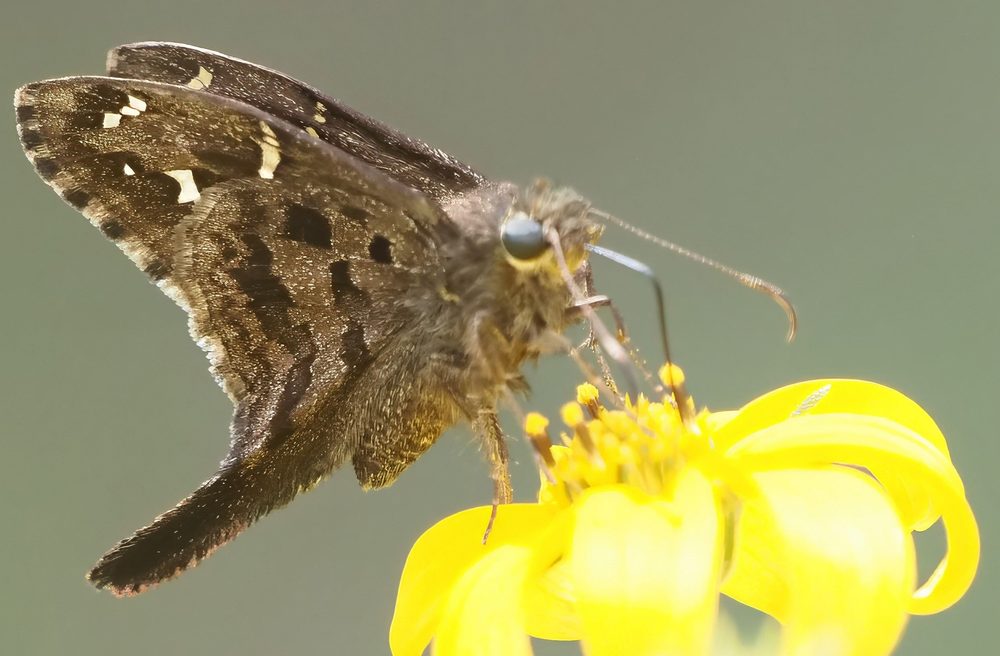
Thanks, Elaine, and best wishes to everyone for butterfly success during the remainder of the year.
Lots of interesting information and data here! How awesome that such surveys are being conducted in New Mexico. Thanks to all who volunteer.